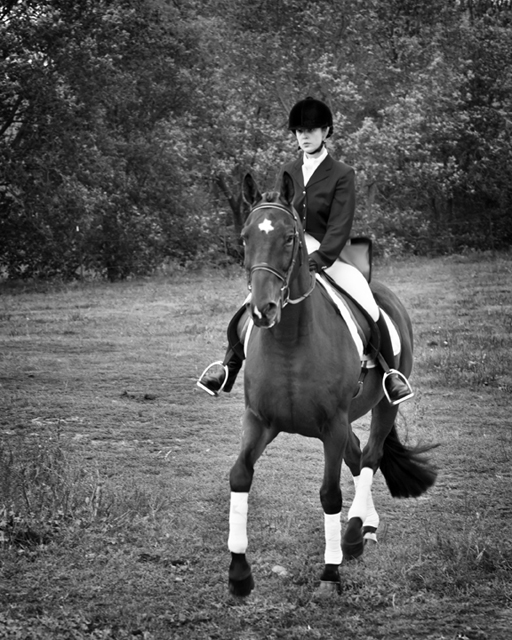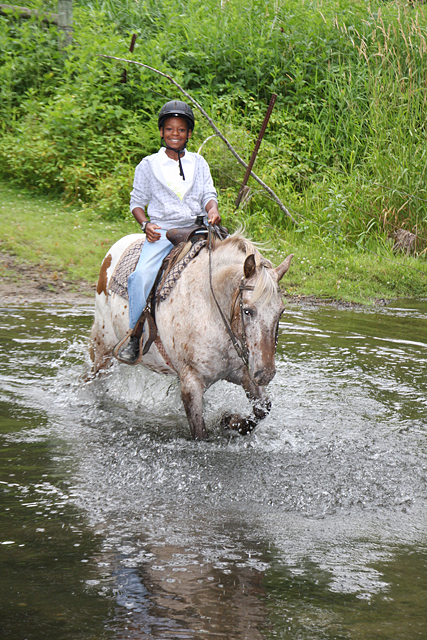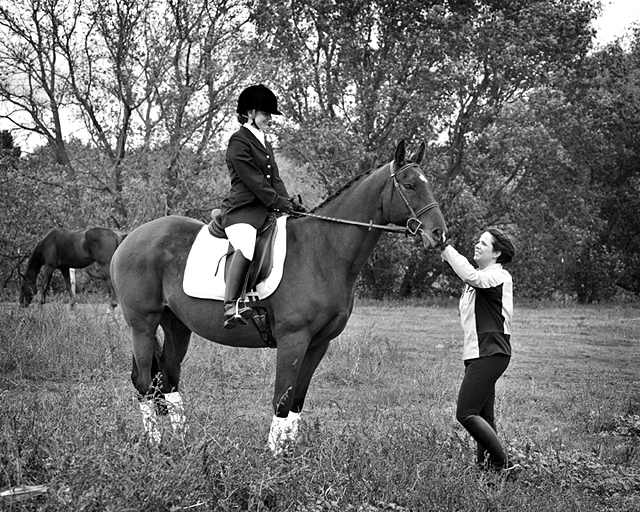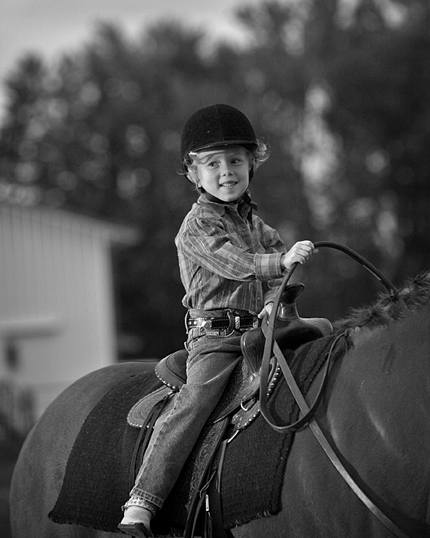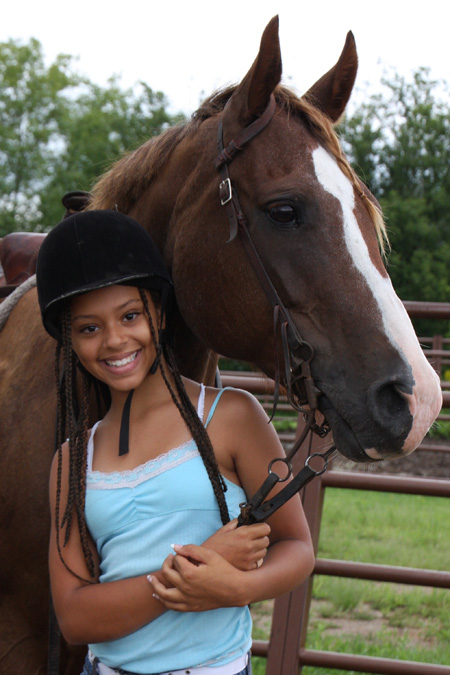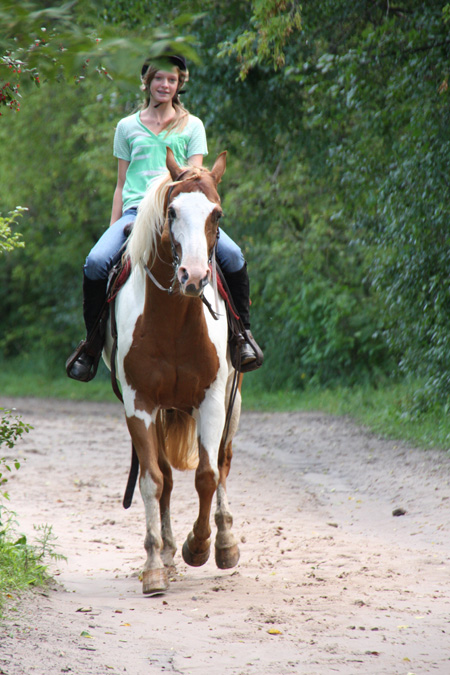

Here along the beautiful Kinnickinnic River, something beyond efficiency, cleanliness and thoughtful planning are at work. Contented, gentle, well groomed horses and letters from grateful customers point to a philosophy of caring and respect that extends from people to animals. Carolyn will tell you that the family's top priorities for customers are safety and individual attention.
Indeed, not all stables and owners are alike.
Tom's affinity to horses began over sixty years ago while working on the 260-acre family farm with his father, a man who preferred a team of Belgian horses to a tractor. Tom wasn't yet out of high school when his father died and he took over the farm's management. For the next 17 years he had little time for anything beyond dairying, marrying Bev and raising four daughters. But soon after Carolyn, the youngest, was born, his plans for a trail riding stable took shape, and in 1963 the business became reality.
The Lowe children shared Tom's energy and enthusiasm for horses and horsemanship, helping with the stable, taking special courses at the University of Wisconsin - River Falls, and becoming accomplished horsewomen. They helped to make Kinni Valley one of the oldest, continuously-run, family-owned businesses in River Falls.
But one by one, they graduated from college and moved away.
Carolyn spent time in California as a television commercial producer and riding instructor before refocusing her efforts in the Midwest. She decided her childhood home on the Kinnickinnic River was the best place to grow a business. With her contribution, what began 37 years ago as a 13-horse operation became two stables with 77 horses, two outdoor arenas, a heated indoor riding facility and a variety of riding and driving opportunities for individuals and groups.
Carolyn operates the academy and tack shop, while Tom oversees the riding stable horses and personnel.* According to both of them, Bev manages everything else. All of them work to provide opportunities for customers to learn as much as they want about riding and handling in a variety of ways - lessons, camps, demonstrations, training and leasing.
"What makes us different," says Carolyn, "is that a person can come and say, 'I really like horses. I want to try a trail ride.' They can try trail riding for a little while and if they really enjoy it, they can say 'I'll like to take that a step farther and take lessons.' They then have the ability to go as in depth as they want...with lessons at all different levels."
A lot of stables and academies, she says, offer only one type of riding or specialize in just a few areas. At Kinni Valley, riders can choose from beginning to advanced levels of Western and English riding, jumping, dressage and one-horse or team driving. They can also choose a type of instruction that works best for them.
Safety With Horse Sense
The most important component of a Kinni Valley riding experience is safety.
For this reason, the Lowes pay special attention to the horses they buy and own. Many of them are Quarter Horses, Morgans, Thoroughbreds and Tennessee Walkers, but more important than breed are their individual characteristics. The best and most trustworthy animals display gentle temperament, sturdiness and intelligence.
Carolyn finds that the horses best for trail riding are those that consistently respond to commands, yet automatically do what needs to be done when necessary - like following the other horses while on the trail. Surprisingly, full-sized horses are often best for beginning child riders. One of the family's favorites was a gentle giant who safely carried little ones until he was 42 years old.
"As a rule, ponies are more intelligent than horses," Carolyn says. "And therefore can get into more mischief and make control more challenging."
Still, bad equine behavior causes fewer safety problems than human ignorance.
"About 95 percent of the accidents happen because people don't know where to stand or what to do," says Tom. "Control is a big issue - or not controlling what the horse should be doing."
Sometimes what people think are obvious responses or action, aren't.
"Common sense is something that's common after someone's bothered to mention it," Carolyn says.
For that reason, safe handling and riding practices are stressed with all riders.
"Most of what I tell children about safety is not to make them afraid," she says. "It's so they don't have to be afraid. We should start [teaching] children as early as they're able to pay attention because then we keep them in a safe situation with knowledge."
Lessons
The riding academy offers hourly lessons to students 8-years-old and up, using three instructional approaches: private (one-on-one), semi-private (one or two persons), or group (four to ten persons). Why? Eighteen years of teaching experience convinced Carolyn that people have different learning styles and do better with some than others.
"Some people want just constant communication, and learn as much as they can in a hour with exclusive attention on them. Others are a little bit nervous with that. They want to learn very quickly but they want other people having attention on them at the same time. The people who do best in group lessons are people who can learn by what is said to others, by watching what is going on and then applying [those things] to themselves."
Group participation is based on age, ability and interest. But no matter which type of instruction a rider chooses, each starts with a private lesson to evaluate individual strengths and weaknesses, discuss individual goals and introduce and emphasize equestrian safety.
Day Camps
Summer day camps have become a popular and fun way of learning equestrian skills at Kinni Valley, with children's programs running for five days and adults programs for two days.
Beginners are taught safety, control of horses, bridling, saddling and basic equitation, then are introduced to English riding and driving single horses and teams. Everything comes together with a horse show.
"As ability increases, camps become more specified with placement by skill and interest," Carolyn says. "Children often come to three or four camps per summer, moving up as abilities increase. Older children may move on to learning about feeding and veterinary care, looking to future ownership."
Adult camps are usually scheduled on summer weekends and sometimes throughout the year, in an attempt to work around customers' ever more demanding schedules.
"The climate of education is so different now," says Carolyn. "It's not just children that are learning...adults are taking two days to get 10 or 15 hours of concentrated instruction and information."
Special Programs
Special activities for groups and organizations are available at the stables upon request. Scout groups regularly participate in special badge programs, with several specifically approved by the Indianhead Council of Girl Scouts.
A small but rewarding program is one dedicated to special needs children and adults who call themselves "Renaissance Riders." For more than five years, Kinni Valley has combined horse therapy with the teaching of riding skills for the students' physical and psychological well being.
When its hind legs propel the horse, the rider's back, hip and leg muscles simulate walking. But Carolyn points out that skill mastery, self-esteem and the bond between animal and human are important, too.
"The camaraderie between horse and rider is wonderful," she says. "Horses are so leveling for people of all abilities...[They don't] care if your skin is purple...if your hair is yellow...if you can walk or can't walk...if you can speak or can't speak. If you do the correct thing, the horse will respond. I'm very happy with the results we've had."
Kinni Valley also gives educational presentations to special groups, some of which are made up of people too debilitated to ride.
"The whole program absolutely boggles your mind," Tom says. "To see how these kids and adults react. It's a wonderful thing to get involved with. The payback that we get from it is priceless."
Some people and events deeply touch the Lowes, like the teen who developed riding skills so far beyond the expectations of professionals, she was documented in medical journals. Or the shy horse who avoided most attempts to touch him, but who then reached out to touch a shy, disabled girl.
And there's the horse with the sensitive right ear.
"You can't touch his ear," Tom says. "He moves away, so it makes it difficult for people to ride him."
"One day we had a whole busload of people from the trauma center in Red Wing, and one guy was sitting in his wheelchair, all bent over. Nothing much worked...he was just in bad condition.
Carolyn was demonstrating to the people the differences in the horses...from the littlest to the biggest horses we have. And we brought out this horse [with the sensitive ear], who happens to be part workhorse. He went over to this man in the wheelchair - the guy could hardly move his hands - [and] put his head in the man's lap. The guy started working up and down the horse's face with his hands and playing with [the horse's] right ear. The horse never moved."
The event that still moves Tom to tears involved a man who had raised Appaloosa horses before suffering a traumatic brain injury.
"They brought him out here to see if he could ride - he was in a wheelchair, almost helpless. Three or four of us got him on a horse and led him around. He could hardly talk.
I had a colt in one of the pens out behind the barn. We'd been spoiling it rotten for weeks, everybody playing with it, rubbing and scratching it. While waiting for Carolyn to take [another disabled rider] off her horse, I took this guy out by the pen. The colt put its head up over the fence and its nose near his knee, so he could reach over and run his hand down its mane. The tears started coming down as he said, 'Thank you very much. Thank you.' My tears were coming down too."
Leasing
Kinni Valley leases horses only to customers taking lessons. Leases run for one month at a time, access is for half-days, and the horses are kept and cared for on site. The objectives are to give dedicated students an opportunity to practice between lessons and to give horses additional stimulation and new challenges.
Trail Rides
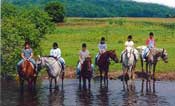
The backbone of Kinni Valley is the trail riding stable, which features one-hour, fully guided rides from 9:30 a.m. to 5:30 p.m., seven days a week throughout the warm months. Special group rides can be arranged at other times. For safety, horses are matched to rider skills and the guide staff is instructed to gear each ride to the ability of the least experience rider.
"The trail riding experience here is about being outdoors, enjoying the scenery and relaxing," Tom says, pointing out that the winding, 3+ mile-long trail crosses the Kinnickinnic River several times and often gives riders a chance to see wildlife such as deer, foxes, hawks and bald eagles.
He's ridden that trail thousands of times and each time finds it beautiful.
The Lowes want to provide a satisfying experience for every customer and encourage new riders to make an appointment to come in for a chat, watch a class from the observation room and go for a trail ride.
"Riding is a sport that involves good feelings and good relationships," Carolyn says. "It's important that the environment and the people are congruent with you."
It's likely you'll find that at Kinni Valley, where it's never too late or early to view the world with a fresh perspective from horseback.
Kinni Valley Stables and Riding Academy is located on Hwy. 65 and 30th Streets, between Interstate-94 and downtown River Falls. For trail riding call: 715-425-6184 or 800-400-6184 in Wisconsin. For other activities and programs call: 715-426-1321. Get Directions.
(Kinni Valley Stables, Inc. and Kinni Valley Riding Academy, LLC are separate businesses located on adjoining properties.)
Gallery